


Warm Koudum


.

In Koudum, a residents' cooperative is working towards a fossil-free village. For the village centre, EXTRAQT modelled a collective heat network supplied by heat from the Koudumer Far lake and seasonal underground storage. We designed the network and built the business case that underpins the choice between a collective and an individual solution.
.
In Koudum, a residents' cooperative is working towards a fossil-free village. For the village centre, EXTRAQT modelled a collective heat network supplied by heat from the Koudumer Far lake and seasonal underground storage. We designed the network and built the business case that underpins the choice between a collective and an individual solution.

A collective solution for the historic village centre
The Warm Koudum working group and the cooperative Duurzaam Koudum aim to take as many households as possible off natural gas. In the less dense parts of the village, individual heat pumps are the obvious choice. In the historic centre that is harder because of aesthetics, noise, limited space and cost. For this part of Koudum, EXTRAQT assessed whether a collective heat network is technically and financially feasible.
Mapping heat demand
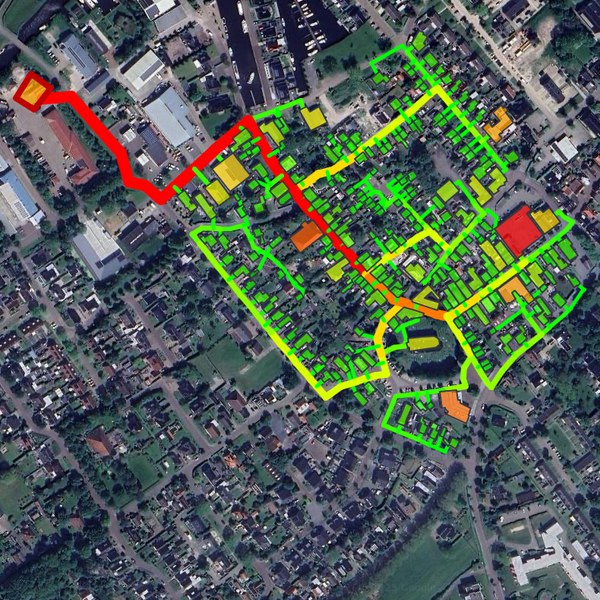
The design starts from a detailed picture of heat demand. It was determined per building, ranging from a few MWh per year for a terraced house to almost 150 MWh for the largest consumers in the centre. This shows where demand is concentrated and which streets carry the network economically.
Designing the heat network
Based on that demand, we laid out the network route, from the energy centre on the edge of the village to every connection. Each pipe section was sized individually: from a DN 125 main line leaving the energy centre to DN 20 house connections. This keeps the diameter, and therefore the investment, matched to the flow each section has to carry. As the source, we modelled aquathermal energy from the Koudumer Far combined with aquifer thermal energy storage (ATES). The ATES stores summer heat for use in winter, so the heat pumps can operate efficiently even when the water is cold.
Scenarios and business case
Alongside the technical design, we developed several scenarios and compared them in a business case. They differed in the number of connections, source configuration and phasing. For each one, investments, operating costs and the heat price for residents were set side by side and compared with individual (hybrid) heat pumps. This lets the cooperative decide on solid grounds which scenario to develop further, and communicate its financial feasibility clearly to the village.
Impact
In the developed scenario, more than 275 homes come off natural gas. CO₂ emissions fall by 85%, from 1,458 to 210 tonnes, and primary energy use by 60%. Because the network will be collectively owned, the revenues stay in the village and lower-income households can also take part in the transition.
European support
The feasibility study is part of the Wetterwaarmte programme of Provinsje Fryslân. The project is also supported by AquaCOM, an Interreg North-West Europe project that helps energy communities implement aquathermal energy.


Warm Koudum
.
.



Interested in an aquathermal installation? Read more on our approach on why an aquathermal system migh be interesting for your water body!


